
How to Read a Feed Additive COA: The Viwors Buyer Guide
Viwors prepared this practical feed additive COA guide for feed mills, importers and distributors checking whether an identified batch meets an agreed specification. The document, product and test information must all match.
What is a feed additive COA?
COA means Certificate of Analysis. In feed additive procurement, it is normally a batch-specific document that lists selected quality or safety parameters, their acceptance criteria and the results reported for the identified batch.
A COA is different from a product specification or technical data sheet. A specification describes what the product is expected to meet. A COA reports what was measured or observed for one batch. The certificate should therefore connect a specific product and lot to a set of results.
Reliable analysis matters because feed decisions depend on accurate, reproducible data. The FAO's laboratory quality-assurance guidance emphasizes the importance of reliable analytical data for animal feed, while ISO/IEC 17025 provides a framework for laboratory competence and valid results. Accreditation can increase confidence, but buyers should still check whether the laboratory's accredited scope covers the relevant test.
The 10 fields every buyer should check
- Manufacturer or supplier identity. The legal or trading name and contact details should be consistent with the quotation, invoice and other supplier documents.
- Product name and grade. Confirm the exact product, form and grade. Similar names can refer to different concentrations or formulations.
- Batch or lot number. The COA number and batch identifier should match the bag label, sample label and shipping documents. A COA without a traceable lot is difficult to connect to the goods received.
- Manufacture, test and expiry dates. Review the sequence and confirm that the remaining shelf life matches the purchase agreement and intended use.
- Test item. Each row should identify what was tested: active content or activity, moisture, particle size, heavy metals, microbiological limits or another relevant parameter.
- Specification or acceptance criterion. Look for a minimum, maximum, range or qualitative requirement such as “Negative in 25 g.” Avoid assuming that every market or application uses the same limit.
- Actual result. The result should be stated clearly rather than shown only as “Pass” when a numeric measurement is expected. Confirm that it meets the corresponding specification.
- Unit. Units such as U/g, %, mg/kg or CFU/g are not interchangeable. Compare the result and specification only after confirming they use the same basis and unit.
- Test method and laboratory identity. The document should identify the method or internal procedure sufficiently for clarification. If an external laboratory performed the test, check its name, report reference and relevant scope.
- Authorization and document control. Look for the approver's name or role, approval date, certificate number and revision or page control. A signature or stamp alone does not replace traceability.
Specification vs result: the most important distinction
Buyers often look only for the word “Pass.” A better review compares four items on the same row: test item → specification → result → unit/method.
| COA field | What it means | Buyer question |
|---|---|---|
| Specification | The agreed limit or range | Does it match the purchase specification? |
| Result | The reported value for the batch | Is it within the limit or range? |
| Unit | The measurement basis | Are the specification and result directly comparable? |
| Method | How the test was performed | Is the method identifiable and suitable for the parameter? |
For example, if enzyme activity is specified as not less than 2,000 U/g and the result is 2,180 U/g, the reported value is above the minimum. That comparison is meaningful only if the same unit, sampling basis and suitable test method are used.
Worked example: glucose oxidase mycotoxin binder
The table below uses fictitious educational data from our downloadable sample. It demonstrates how to read the columns; it does not describe a commercial Viwors batch or establish a recommended product specification.
| Illustrative item | Illustrative specification | Illustrative result | How to read it |
|---|---|---|---|
| Glucose oxidase activity | ≥ 2,000 U/g | 2,180 U/g | Above the stated minimum |
| Moisture | ≤ 10.0% | 7.2% | Below the stated maximum |
| 40-mesh pass rate | ≥ 95.0% | 97.6% | Above the stated minimum |
| Lead (Pb) | ≤ 10 mg/kg | 2.1 mg/kg | Below the stated maximum |
| Salmonella | Negative / 25 g | Negative / 25 g | Matches the qualitative requirement |
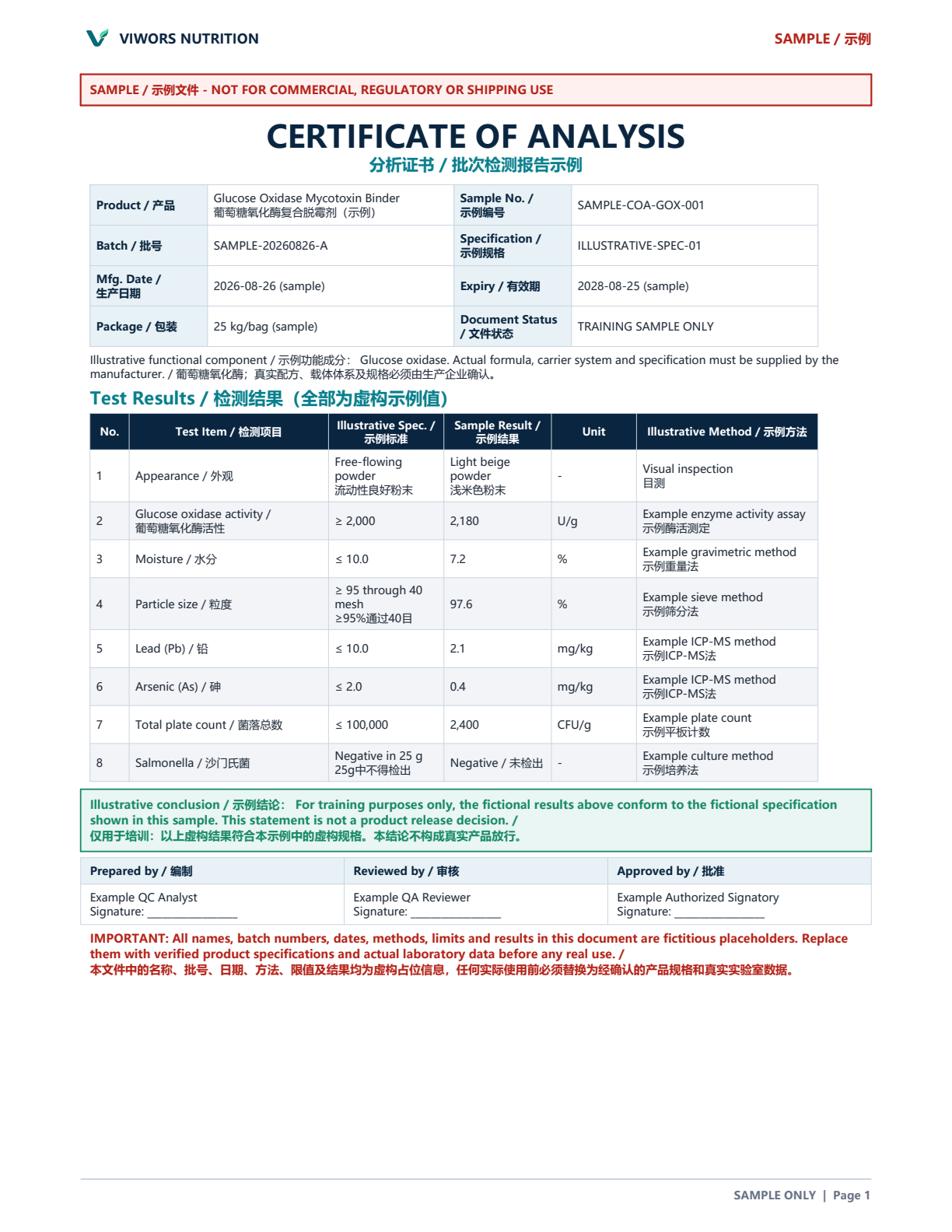
Download the Viwors bilingual sample COA
Use this two-page Viwors feed additive COA sample PDF to learn the layout of an English–Chinese certificate. It includes document control, batch details, specifications, results, methods and approval fields.
Educational sample only. All values and identifiers are fictitious. This file is not valid for sale, customs, registration, regulatory submission, product release or shipment.
Seven red flags on a feed additive COA
- The batch number is missing or does not match the label.
- The same result appears on every batch without explanation.
- Numeric tests show only “Pass” and no measured value.
- The unit, method, laboratory or report reference is unclear.
- The certificate date is inconsistent with the manufacture or test date.
- The product name, concentration or grade differs from the purchase order.
- The document has visible alterations, incomplete pages or no controlled approval.
One red flag does not automatically prove that a document is false. It does mean the buyer should pause and ask for clarification or supporting records before approving the batch.
How to verify a COA with the supplier
Use the certificate as one part of a wider receiving and supplier-verification process:
- Send the supplier the COA number and lot number and ask them to confirm the record.
- Compare the COA with the approved specification, label artwork, sample and purchase order.
- Ask who performed each test and whether any result came from an external laboratory.
- For accredited testing, request the laboratory report and verify that the relevant method is within the laboratory's scope—not merely that the laboratory holds a certificate.
- Retain receiving, lot and distribution records according to your quality system and applicable market rules. For example, FDA guidance for animal food businesses highlights lot or other identifiers as part of receipt and distribution traceability in the United States.
- Use independent testing when the product, market, supplier history or risk assessment justifies it.
For a broader review, use the Viwors feed additive quality checklist, see the Viwors procurement process, and review the relevant Viwors mycotoxin binder product page.
Feed additive COA FAQ
What does COA mean in feed additives?
COA means Certificate of Analysis. It reports selected test results for an identified batch against stated specifications. It should be reviewed together with the specification, label and batch records.
Is a supplier COA enough to approve a feed additive?
No single document is enough for every risk level. Match the certificate to the goods, review the method and laboratory information, and use independent testing when required by your quality plan or market.
Should every COA show the test method and unit?
For quantitative results, a clear unit and identifiable method make the result easier to interpret and reproduce. Ask for clarification if either is missing.
Does an ISO/IEC 17025 logo prove every result is accredited?
Not necessarily. Check the laboratory name, report reference and accreditation scope to see whether it covers the relevant test and method.
Where can I download a Viwors feed additive COA sample PDF?
The Viwors COA buyer guide includes the bilingual PDF above. It is visibly marked as an educational sample and contains fictitious data, so it must never be presented as a real batch certificate or used for customs or registration.
Viwors feed additive quality document support
When evaluating an actual Viwors product, buyers can ask the sales team about the available product specification, technical sheet, label information, sample documents and batch-specific COA. Document availability and content depend on the actual product, batch and destination-market requirements; the educational sample on this page does not replace those records.
Sources and further reading
- ISO/IEC 17025 — Testing and calibration laboratories
- FAO — Quality assurance for animal feed analysis laboratories
- U.S. FDA — How do I start an animal food business?
Request Viwors feed additive quality documents
Tell Viwors the product, species, destination market and required specification. We can discuss available product documents, samples, packaging and export support. Final documents depend on the actual product and batch.
Request product documents View mycotoxin binder